Queering my Childhood: Recognizing My Queerness in Pop Culture's Margins

Hey folx,
I didn’t grow up with the word “queer”—not in any kind of affirming way. I grew up in a world that insisted on neat categories and strict rules, a world that didn’t have space for someone like me. But I also grew up with Gonzo. And Power Rangers. And Mary Poppins descending from the sky like a bedazzled gender-agnostic guardian angel. Before I had language for queerness, I had recognition—something José Esteban Muñoz called the “ephemeral traces of queer existence,” where queerness isn’t always declared but deeply felt (Muñoz, 2009).
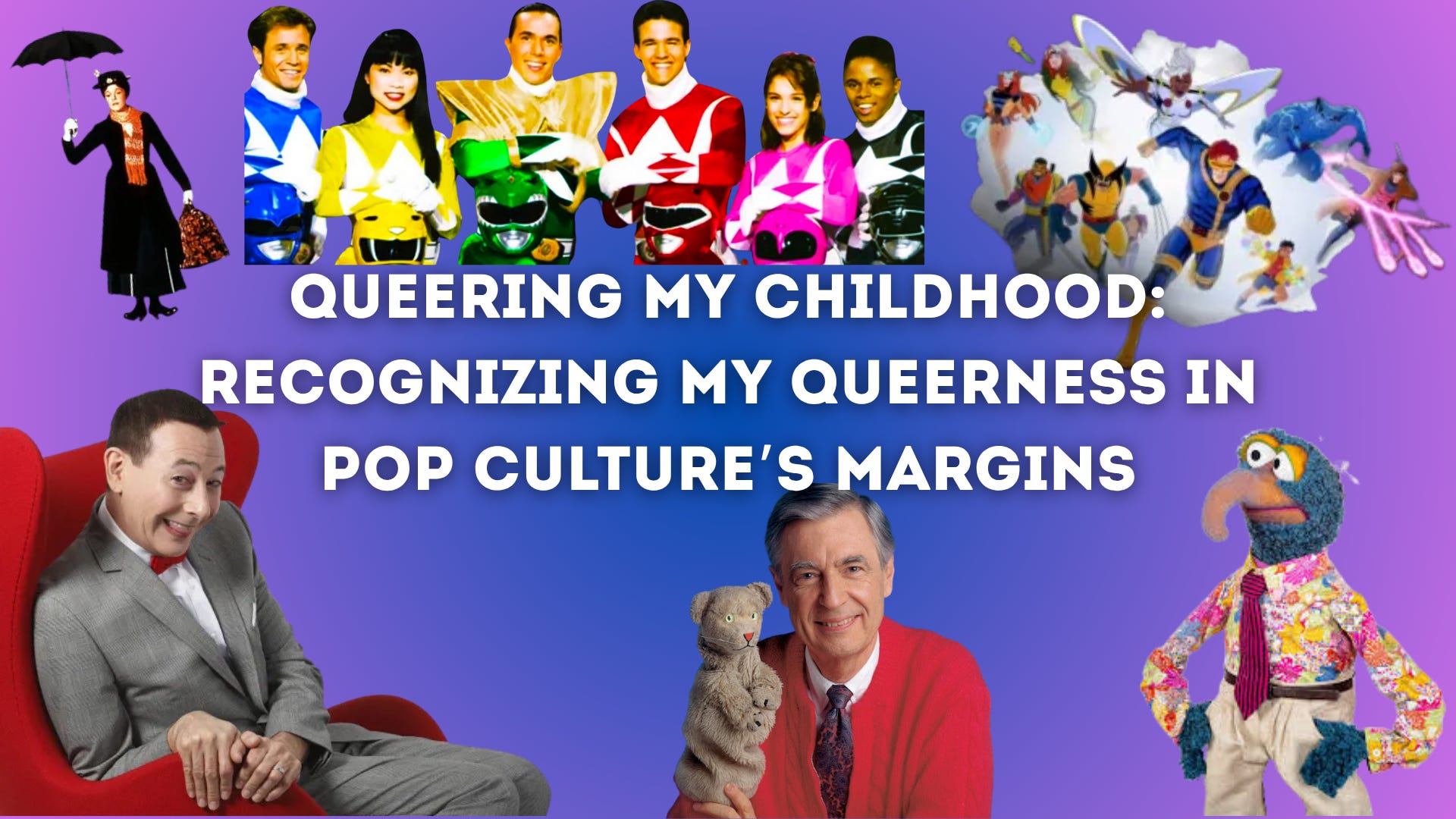
No one on The Muppets told me Gonzo was queer. But he was the only character whose species was “unknown,” who loved chickens and chaos, who wore tuxedos and tutus with equal flair. Gonzo wasn’t just odd—he relished his difference. As a child who already felt at odds with the expectations around me, Gonzo’s gleeful weirdness offered a model of life beyond binaries. Jack Halberstam writes about the “queer art of failure,” and Gonzo was its pioneer—failing gloriously, expressively, and often in sequins (Halberstam, 2011).
Around the same time, I became obsessed with Power Rangers. I wasn’t just watching for the fight choreography—I was captivated by the way characters transformed, color-coded their identities, and formed bonds that felt deeper than friendship. I didn’t want to be the Red Ranger; I wanted to be all of them. Especially the Pink one. Looking back, I realize that the series presented a version of chosen family and identity play that mirrored queer experience, long before I knew that’s what I was drawn to.
The X-Men comics and cartoons added layers to this recognition. Mutants had to hide their powers, feared rejection from their families, and found community only in one another. I may not have had telekinesis, but I knew what it was like to hide a core part of myself to stay safe. I knew what it meant to long for a world where being different wasn’t dangerous. The X-Men weren’t just superheroes—they were, as Alexander Doty would say, “coded texts” that made space for queer readings even if no one said the word out loud (Doty, 1993).
Then there was Mary Poppins. Magical. Composed. Irreverently proper. She wasn’t anyone’s wife or mother—she arrived on her own terms, rewrote the rules, and flew away when she was done. There was something so thrilling about a character who didn’t explain herself. She wielded femininity like a drag queen wields a fan—decisively, with wit and purpose. I didn’t want to be her because she was a woman. I wanted to be her because she wasn’t normal, and because being normal seemed to be the only thing I was failing at.
If Mary Poppins was queer in her flamboyant defiance, then Captain Planet was queer in his earnest collectivism. Five kids with elemental rings—one of them bearing the most ridiculed but essential power of all: Heart. It was the one I felt closest to. The capacity to care deeply, to form bonds, to feel things that others rolled their eyes at—that was queerness, too. Feeling was a threat to systems that demanded stoicism. Even then, I sensed that my emotional intensity didn’t belong in the masculine world I was being prepared for.
And when I needed softness and safety, I found it in Mr. Rogers’ Neighborhood. Fred Rogers was perhaps the first adult man I saw model emotional literacy and gentle masculinity. He put on sweaters instead of armor. He made space for difference and asked children—all children—to believe in their inherent worth. Mr. Rogers didn’t make me queer, but he gave me a glimpse of what queer-adjacent safety looked like. Halberstam notes that queerness often exists in the margins, and I think that cardigan-clad margin shaped something essential in me.
On the more chaotic end of the spectrum was Pee-Wee Herman—a postmodern mashup of man-child drag, surrealism, and high camp. Pee-Wee’s Playhouse was a carnival of queer affect. Everything was over the top. Nothing made logical sense. Furniture talked. Adults played. Colors clashed. And Pee-Wee? He wasn’t like any adult I’d ever seen. He was performing adulthood with such sincerity and absurdity that it became something else entirely. Judith Butler might call that “gender trouble”—a performance that exposes the artificiality of norms (Butler, 1990). Pee-Wee wasn’t just weird. He was sacredly weird.
As I absorbed these pop culture moments, I was also performing in my own life. I played soccer and baseball, but I was better at choir and band. I joined the theatre and entered beauty pageants with a kind of giddy joy that confused some adults but thrilled me. I tried football and failed. Tried cross country and sank. Tried water polo and sank harder. But in music, movement, and make-believe? I thrived. Not because I was hiding, but because the stage offered something that the world didn’t: a place to try on versions of myself.
Performance was never just a hobby. It was a lifeline. A language. An invitation. In many ways, I was doing what Muñoz describes as “disidentification”—engaging with dominant culture while resisting its terms and reworking them for my own survival (Muñoz, 1999). I wasn't out, but I was visible—if only to myself.
So no, none of these shows or activities made me queer. But they were the breadcrumbs. They were the clues. They were the glitter bombs of recognition. Queer kids are always reading between the lines, tuning into subtext, imagining otherwise. That’s part of the queer imagination. It doesn’t just dream new worlds—it recognizes them wherever it can.
Today, when I teach, perform, or parent, I think about the queer ghosts who haunted my childhood TV screen. I think about how they whispered possibility, how they cracked open the rigidity of normativity, how they showed me—without saying a word—that there were other ways to be.
And I carry those lessons with me, like Gonzo’s cape, Mr. Rogers’ sweater, and Mary Poppins’ umbrella—each one a portal to something freer, weirder, and truer.
References
Butler, J. (1990). Gender trouble: Feminism and the subversion of identity. Routledge.
Doty, A. (1993). Making things perfectly queer: Interpreting mass culture. University of Minnesota Press.
Halberstam, J. (2011). The queer art of failure. Duke University Press.
Muñoz, J. E. (1999). Disidentifications: Queers of color and the performance of politics. University of Minnesota Press.
Muñoz, J. E. (2009). Cruising utopia: The then and there of queer futurity. NYU Press.